Voltage Tester Explained: A UK Buyer's Guide
TL;DR: What does a voltage tester do?
A voltage tester tells you one thing: whether a socket, light fitting or cable is live. If a socket at home has gone dead and you want to check it yourself before calling anyone out, a non-contact voltage tester is the safest place to start — it beeps or lights up near live wiring without you touching a single conductor. Anything beyond checking from the outside — inside the consumer unit, or into the wiring itself — is where you stop and hand over to a registered electrician.
Key Takeaways
- A voltage tester answers one question — is this live? — which is exactly what you need to know when a socket stops working.
- For a first purchase, a non-contact voltage tester is the safest starting point: nothing metal to touch, nothing to dismantle.
- Two-pole testers and multimeters give more definite answers, but they put probes in your hands — a step up in confidence and care.
- UK homes run at 230 V — more than enough to be lethal — so a tester carrying a genuine CAT III rating is not optional.
- Know your stopping point: inside the consumer unit and anything in the fixed wiring is a registered electrician's territory.
You do not need to be an electrician to want a voltage tester. Most first buyers are homeowners who simply want to know whether a dead socket means a tripped switch, a failed appliance or something worse — before deciding whether to pick up the phone. This guide explains what a voltage tester is, which type makes sense at home, and, just as importantly, where a sensible DIY check should end.
What is a voltage tester?
A voltage tester is a hand-held tool that detects whether electrical voltage is present at the point you are checking. The simplest kinds only indicate presence — a beep or a glowing tip. Two-pole types show the approximate level, and a multimeter set to its voltage range reads the actual number: a healthy UK socket measures around 230 V.
What a voltage tester does not do is check whether a wire, fuse or connection is unbroken once the power is off — that is a separate job for a continuity tester. This guide sticks to live detection: finding out whether something is carrying power right now.
Which type is safest for checking things at home?
Non-contact voltage tester — the safest first buy
A non-contact voltage tester looks like a chunky pen. Hold the tip near a cable, socket or switch and it beeps or lights up if live voltage is present — no exposed metal, no contact with any conductor, nothing to unscrew. If this is your first tester and you are honestly a little wary of electricity, this is the type to buy, because the tool itself keeps you at a distance from the thing you are worried about.
Its limit is the flip side of that convenience: it is a screening tool. Shielding, metal back boxes or a deeply buried cable can mute the signal, so silence is never proof that a circuit is dead — read "no beep" as "probably", not "definitely".
For a dead socket specifically, a plug-in socket tester makes a useful companion: push it in like a plug and its lights report the common wiring faults. It only works on sockets — but a socket is often exactly where the question is.
Two-pole tester — the electrician's standard
A two-pole tester has two probes and confirms voltage between two real points, which makes it far more dependable than sensing through insulation. It is what electricians use to prove a circuit dead as part of a formal safe isolation routine. For a homeowner it offers proper certainty, but the probes must touch terminals to do their job — so it earns a place in your drawer once you are comfortable working at socket-faceplate level, and everything deeper stays professional work.
Multimeter on the voltage range — the most information
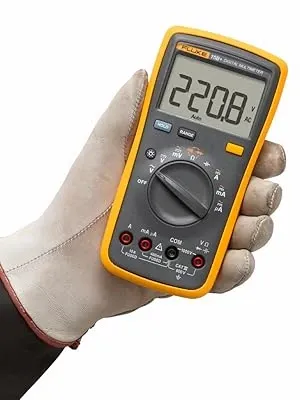
A multimeter measures the actual voltage rather than just detecting it, and adds continuity, resistance and battery checks for the rest of household life. The learning curve is smaller than it looks: an auto-ranging model with a backlit display picks the right range for you and stays readable under a worktop, which removes most of the dial-guessing that puts first-time users off.
One honest warning: the very cheapest meters defeat the point of owning one. A £15 bargain-bin meter that flickers between readings leaves you less sure than before you started — and with electricity, a tool you cannot trust is worse than no tool at all.
Checking a dead socket: a safe first look
Take the classic case: one socket in the living room has stopped working. Before any tester comes out, look at the consumer unit (the fuse box) — without opening anything or removing any cover. If a breaker or the RCD has tripped, reset it once. If it trips again, stop: repeated tripping means a fault somewhere, and finding it is an electrician's job.
If nothing has tripped, plug in a lamp you know works to rule out the appliance. Then sweep a non-contact tester around the socket face. A confident beep says power is reaching the socket, so suspicion moves to the appliance, plug or fuse; silence suggests the feed to that socket has failed somewhere upstream in the fixed wiring.
That is the natural end of a DIY check. If you have got this far without an answer, the fault sits behind the wall or inside the consumer unit — exactly where amateur probing goes wrong. And if part of you feels uneasy about going further, listen to it: around electricity, caution is not a lack of ability, it is the ability.
What to look for when buying your first voltage tester
- A genuine CAT III rating. Home sockets sit on 230 V circuits fed straight from the consumer unit, so the safety category matters even for occasional use — our CAT III multimeter guide explains the rating system in plain English.
- Safe probe design, if it has probes. Look for fused leads with shrouded tips built to GS38 test leads guidance, the UK benchmark for probe safety.
- Clear, unambiguous indication. A loud beep and a bright display beat a faint LED you have to squint at in a dim hallway.
- Ease of use over feature count. Auto-ranging and a backlit screen will do more for you than a dozen modes the dial never visits.
On budget: a basic non-contact tester costs little and is a perfectly sensible first purchase on its own. If you would rather buy once and grow into it, the Digimeter Pro True-RMS (£176.02 inc VAT) is a full multimeter rated CAT III 600 V, with auto-ranging and a backlit display. That is real money for occasional DIY — which is exactly why the 30-day returns and the 12-month UK warranty matter: if it turns out to be more meter than you need, you are not stuck with it.
When to stop and call a registered electrician
A voltage tester is for finding out what is going on from the outside — it is not a licence to fix what you find. Hand the job over when:
- the answer sits inside the consumer unit — behind that cover is live distribution equipment, and no home check requires opening it;
- you suspect a fault in the fixed wiring — the cables buried in walls, ceilings and floors;
- a breaker or RCD keeps tripping after one reset;
- anything smells hot, buzzes or shows scorch marks — stop using that circuit and call the same day;
- you want the whole installation assessed — after buying an older house, for example — in which case ask for an EICR (Electrical Installation Condition Report) rather than testing socket by socket.
Knowing where this line sits is not a failure of DIY spirit. Finding the problem yourself and briefing an electrician accurately is the competent version of the job.
Frequently Asked Questions
Can a voltage tester tell me if my house wiring is safe?
No — it only tells you whether one point is live at that moment. Overall condition (earthing, insulation, connections) is assessed through an EICR carried out by a registered electrician with calibrated instruments.
Do I need to switch the power off before using one?
Not for the checks in this guide: non-contact sweeps and plug-in socket testers are designed to be used on live circuits from the outside. The moment a job would involve unscrewing anything, the power goes off at the consumer unit first — and if you are not sure how to isolate it safely, that is your cue to hand over.
Why does my non-contact tester beep on a cable I have switched off?
Usually induced voltage: a dead cable running alongside live ones can pick up enough of a field to trigger the sensor. It is a known quirk of the type, and the safe way to read it is simple — treat any beep as live.
Is a multimeter overkill for a homeowner?
Not if you will use it more than once a year. Batteries, fuses, car and bike electrics, a suspect extension lead — mains sockets are only one of the jobs it covers. For a single dead-socket mystery, though, a non-contact tester plus a socket tester answers most of the question for far less money.
Ready for a meter you can trust?
12-month UK warranty · 30-day returns · Free UK next-day delivery on orders over £50
Shop Digimeter Pro TRMS — £176.02