Continuity Testers: A UK Buyer's Guide to Fast Fault Finding
For most electricians chasing breaks on a rewire, buy a multimeter with an instant, latch-free continuity beeper that is loud enough for a noisy site. Choose a dedicated continuity tester only if you need simple, occasional pass-or-fail checks and no other measurements. Whichever you choose, continuity mode is for an isolated, proved-dead circuit—not live-voltage verification.
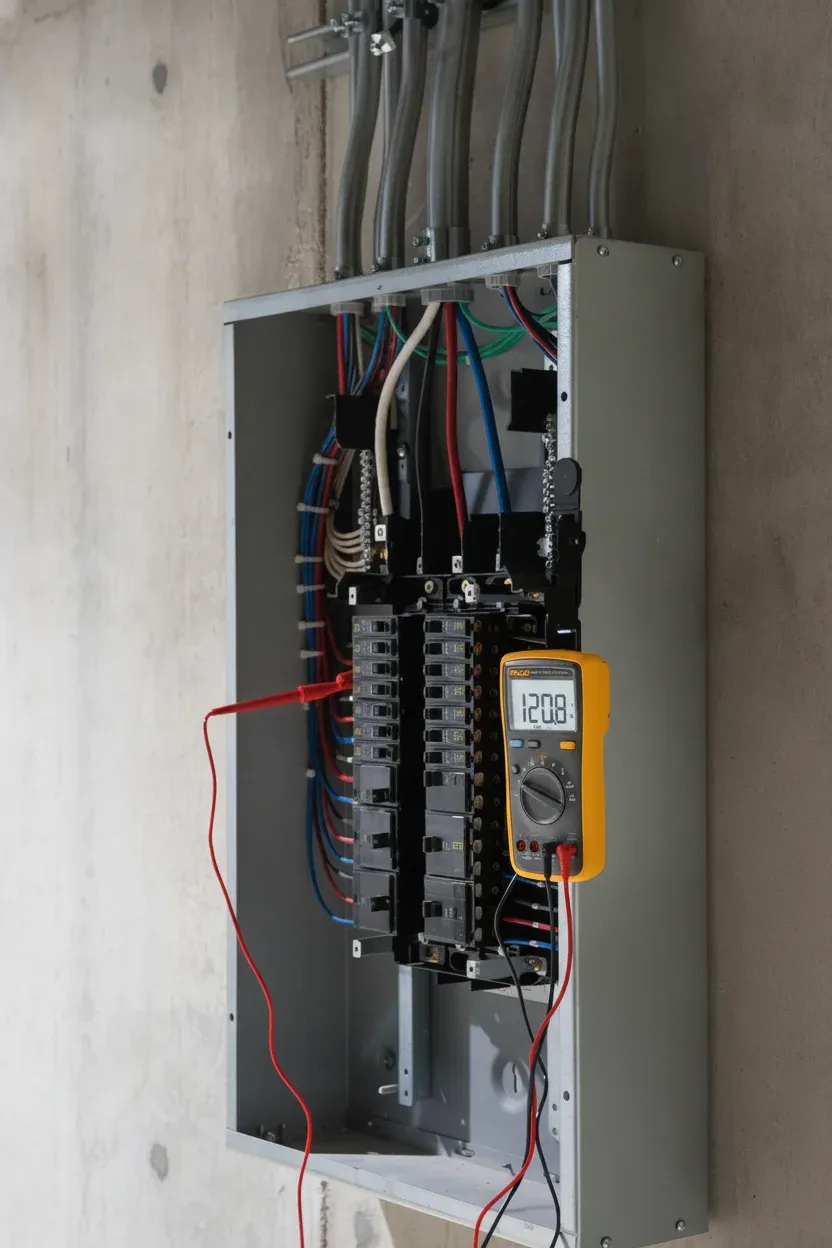
What Does a Continuity Tester Do?
A continuity tester checks whether an isolated wire, fuse, switch or connection has a complete electrical path between two accessible points. The instrument applies a small signal from its own battery; if the measured resistance is below that model's threshold, it shows a result and usually sounds a buzzer.
That makes it useful for checking cable cores end to end, confirming switch contacts and narrowing an open circuit during a rewire. A beep means the tester has found a sufficiently low-resistance path. It does not prove zero resistance, insulation integrity, load performance or that the installation satisfies every part of a BS 7671-based inspection.
Continuity tester vs multimeter
A dedicated tester is the simpler choice for occasional pass-or-fail checks on de-energised conductors. A multimeter with continuity mode is usually the better tool-bag choice for an electrician because the same instrument can also provide resistance and voltage measurements needed to investigate the fault further.
The trade-off is usability: extra modes are no advantage if the continuity response is hesitant or the control layout slows repeated checks. If you need the wider functions as well, use our AC DC multimeter guide to understand what the other measurement modes cover.
Why Buzzer Speed and Volume Matter for Fault Finding
On an old-house rewire, a damaged conductor or loose termination may make contact only as a cable is moved. A slow response can make that brief change easy to miss, sending you back to reopen accessories and repeat the same checks. An instant, latch-free beeper makes it easier to follow the actual probe contact and trace a hidden break with less rework.
Volume matters for the same reason. A faint tone can disappear under drilling, extraction and conversation, so choose a buzzer you can hear on a noisy site and a clear visual indication for times when hearing protection is in use. Before tracing a run, touch the probes together to learn the response and then divide the circuit into sections; that is quicker and more reliable than testing the full run repeatedly.
Do not judge the result by sound alone when a poor joint is possible. Read the displayed resistance where available and investigate an unstable or unexpectedly high value rather than treating every beep as a sound connection.
How to Use a Continuity Tester Safely on a Rewire
Never put a standard continuity tester or a multimeter in continuity mode across an energised circuit. The continuity function uses the meter's own battery, and it is not the instrument used to prove a circuit dead.
- Isolate: identify the correct circuit, switch it off, secure the isolation and control any alternative supplies using your established safe-isolation procedure.
- Prove dead: prove the approved voltage indicator, test all relevant conductors, then re-prove the indicator before moving to continuity testing.
- Inspect: check the tester, probes and insulation for damage. HSE guidance is the on-site benchmark for probe design and protection; see our guide to GS38 test leads.
- Test: select continuity, touch the probes together to confirm the indication, then place them on the two accessible points of the isolated conductor or component.
- Interpret: compare the sound with the displayed value, investigate an unstable result and complete the appropriate inspection before returning the circuit to service.
Parallel paths through connected equipment can create a misleading beep, so disconnect the conductor or component where the test method calls for it. If you cannot secure the isolation or identify every possible supply, stop rather than treating a silence or beep as proof of safety.
Continuity Tester FAQs
Does continuity mean zero ohms?
No. Probe and conductor resistance normally produce a small non-zero reading, and a buzzer operates below a manufacturer-set threshold. Null or note the lead resistance where the measurement method requires an actual resistance value.
Can a multimeter replace a dedicated tester?
Yes, provided its continuity mode responds cleanly enough for the work and its leads suit the access points. A dedicated unit still makes sense when the only task is occasional pass-or-fail checking.
Can a continuity tester check earthing?
It can show that an earthing or bonding conductor has a path between two points, but a simple audible result does not verify that path to the standard needed for installation certification. Use the prescribed test method and instrument for the inspection being recorded.
Can it find a cable break behind a wall?
It can narrow the fault to the section between accessible test points, but it does not reveal the exact position inside a wall. Split the run at accessories or junctions; a cable tracer may be needed when there are no intermediate access points.
Why does the tester beep only when I flex the cable?
That behaviour points to an intermittent conductor, termination or probe contact. Keep the circuit isolated, rule out the probes first, then test shorter sections rather than accepting the momentary beep as a repair.
Conclusion: Choose for Fast, Repeatable Fault Finding
A dedicated continuity tester is enough for occasional binary checks. For rewire and call-out work, a multimeter with a loud, immediate continuity response, dependable leads and an appropriate category rating usually earns its space by helping you isolate hidden breaks without reopening the same points.
Buy against the next job: confirm the beeper behaviour, lead handling, delivery promise and returns cover, then use the instrument only after the circuit has been isolated and proved dead.
Ready for faster fault finding?
12-month UK warranty · 30-day returns · Free UK next-day delivery on orders over £50
Digimeter Pro TRMS — £176.02