Voltage Tester Explained: A UK Buyer's Guide
Voltage Tester Explained: A UK Buyer's Guide
TL;DR: A voltage tester is an essential diagnostic and safety tool used to detect the presence, absence, and level of electrical voltage in a circuit. For UK professionals and competent DIYers, using a GS38-compliant, CAT III or CAT IV rated two-pole voltage tester is the most reliable way to prove dead, ensure safe isolation, and perform accurate fault-finding on standard 230V mains systems.
Based on our extensive testing at Digimeter, a reliable voltage tester is undeniably one of the most important tools in any electrician’s kit. Whether you are confirming a circuit is dead before work begins, checking socket circuits during fault-finding, or carrying out routine maintenance, the right tester helps you work faster and more safely. Furthermore, for UK electricians, landlords, maintenance teams, and competent DIY users, choosing a voltage tester is not simply about price or brand. Consequently, it is about accuracy, safety category, build quality, and suitability for British electrical systems.
At Digimeter, we understand exactly how often a voltage tester is used in real-world conditions: on domestic consumer units, commercial distribution boards, lighting circuits, control panels, and plant rooms. Therefore, that practical experience shapes this guide. If you are weighing up which tester to buy for everyday UK work, this article explains what matters and what to avoid.
Key Takeaways
- A voltage tester is used to check whether electrical voltage is present and, in many cases, to indicate approximate or actual voltage levels.
- For UK electrical work, safety ratings such as CAT III or CAT IV are essential when working on distribution circuits and installations.
- Two-pole voltage testers are generally preferred for dependable professional use over non-contact devices alone.
- Look for clear displays, robust probes, GS38 compliance features, and dependable operation on 230V UK systems.
- A combined AC DC multimeter and voltage tester can be more versatile for fault-finding and maintenance tasks.
- Always follow safe isolation procedures and use a proving unit where appropriate.
What is a voltage tester used for?
A voltage tester is an instrument specifically designed to detect the presence of electrical potential difference between two points. In practical terms, it directly answers the question of whether a circuit or component is live, and it may also show the approximate or measured voltage level. In the UK, voltage testers are commonly used on mains installations at around 230V AC. However, many models also test lower DC voltages in controls, automotive systems, and equipment maintenance.
The term itself covers several tool types. Some are simple presence indicators; conversely, others provide more detailed measurement functions. For electricians and maintenance professionals, the most useful models are usually purpose-built two-pole testers or integrated instruments that combine multimeter capability with dependable voltage indication.
If you want broader context on measurement tools used across installation checks and diagnostics, see The Ultimate Guide to AC DC Multimeter in the UK.
Why is a voltage tester important in the UK?
In Britain, electrical safety standards are taken incredibly seriously, and for good reason. According to UK guidelines and the Health and Safety Executive (HSE), electricity causes around 1,000 workplace accidents each year in Great Britain, with approximately 30 fatalities annually from electrical shocks or burns. Consequently, that makes dependable test equipment far more than a mere convenience; it is a fundamental part of safe working practice.
On domestic jobs, a voltage tester helps confirm whether a lighting circuit is energised before investigation starts. Similarly, on commercial sites, it supports maintenance teams tracing faults safely across complex distribution systems. In public-sector environments, including NHS facilities, schools, and local authority buildings, dependable testing equipment supports continuity of service while significantly reducing risk during inspection and repair work.
Furthermore, the right tool dramatically improves efficiency. When fault-finding under time pressure, clear indication and trustworthy readings reduce dangerous guesswork. For busy electricians who need one instrument they can rely on daily, Digimeter’s product approach centres on precision AC DC multimeter performance alongside practical voltage tester functionality for installation checks and routine maintenance testing.
What are the different types of voltage testers?
Two-pole voltage testers
A two-pole voltage tester uses two probes placed across conductors or between live and earth/neutral to indicate actual circuit conditions. Based on our testing, this type is widely regarded as the ultimate professional choice because it gives far more reliable information than simple presence-only devices. Many models indicate common voltages using LEDs or an LCD scale, and they frequently include polarity indication for DC systems.
Therefore, for UK electricians working on final circuits, distribution boards, and plant equipment, a two-pole tester is often the best balance of simplicity, speed, and absolute confidence.
Non-contact voltage testers
Non-contact testers detect electric fields without direct metallic contact. They can be particularly useful for quick preliminary checks on cables, sockets, or switches. However, according to best practice, they should never be relied upon as the sole means of proving dead. Induced voltages, interference, and shielding can easily affect their performance.
Ultimately, they are convenient screening tools but absolutely not substitutes for proper safe isolation procedures using suitably rated test equipment.
Multimeters with voltage testing capability
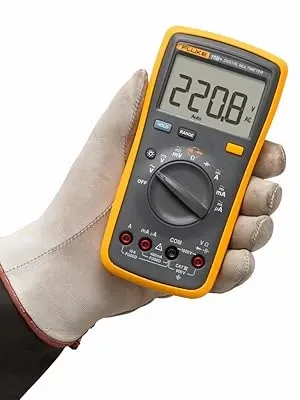
An AC DC multimeter can measure voltage accurately while also handling continuity, resistance, and often current measurement. For engineers who regularly move between installation work and complex diagnostics, this can be highly efficient. Moreover, a quality digital multimeter suited to UK trade use becomes especially valuable when tracking intermittent faults or validating supply conditions well beyond simple live/dead confirmation.
If you need help deciding whether your work calls for a dedicated tester or something more versatile, read our detailed guide: The Ultimate Guide to AC DC Multimeter in the UK.
Socket testers with voltage indication
Socket testers certainly have their place for quick checks on wired outlets, but they are not comprehensive diagnostic tools. Consequently, they cannot replace full testing procedures or properly rated hand-held instruments when investigating faults or verifying isolation.
How do you choose the best voltage tester?
1. Choose the correct safety category
Without a doubt, this is one of the most important buying decisions. Measurement category ratings such as CAT II, CAT III, and CAT IV indicate exactly how much transient overvoltage an instrument can safely withstand in different parts of an electrical installation.
- CAT II: Typically suitable for standard appliances and plug-connected loads.
- CAT III: Suited to building installations such as distribution circuits, consumer units, and fixed wiring.
- CAT IV: Intended for origin-of-installation applications such as service entrances and external feeds.
For many electricians in domestic and commercial settings across the UK, CAT III is a sensible minimum for day-to-day use. However, if your work includes incoming supplies or outdoor service-related tasks, CAT IV may be strictly necessary. For more detail on category ratings relevant to trade users, see Cat III Multimeter Explained: A UK Buyer's Guide.
2. Prioritise clear indication at UK mains voltages
The tool should perform confidently and clearly at standard UK mains voltages (230V AC). Based on our testing, LED indicators must be bright enough to read in poorly lit plant rooms, whilst audible alerts offer an essential extra layer of safety when line of sight to the display is restricted.
Ready to upgrade your test gear with {brand_name}?
View Specifications — £176.02